

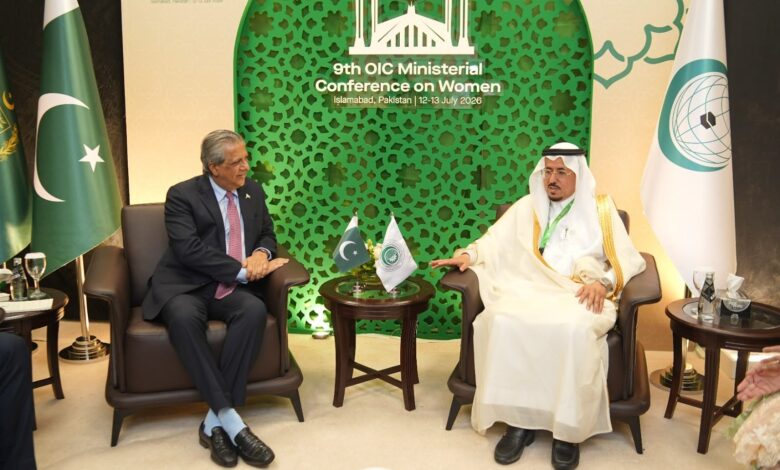

Islamabad (UNA) – Dr. Hadi bin Ali Al-Yami, Executive Director of the Independent Permanent Human Rights Commission of the Organization of Islamic Cooperation (OIC), held a bilateral meeting with Senator Azam Nazir Tarar, Minister of Human Rights of the Islamic Republic of Pakistan, on the sidelines of the Ninth OIC Ministerial Conference on Women, to discuss ways to enhance cooperation in promoting and protecting human rights throughout the OIC region.
The Minister commended the Commission's role in promoting human rights within the framework of the Organization of Islamic Cooperation (OIC), particularly its contributions to the social, economic, and political empowerment of women. He also praised the Commission's work within the OIC's Standing Mechanism for Monitoring the Human Rights Situation in Indian-Occupied Jammu and Kashmir.
He affirmed Pakistan’s support for reaching a peaceful solution to the Jammu and Kashmir dispute in accordance with the relevant UN Security Council resolutions.
The Minister welcomed the Commission’s ongoing institutional reforms, including the formulation of its strategic plan (2026-2030) and its comprehensive digital transformation initiative, which aim to enhance the Commission’s effectiveness, credibility and ability to address emerging and contemporary human rights challenges through evidence-based and innovative policies.
For his part, the Executive Director of the Authority expressed his appreciation to the Government of Pakistan for hosting the Ninth Ministerial Conference of the Organization of Islamic Cooperation on Women, and congratulated Pakistan on assuming its presidency.
He commended Pakistan’s role and valuable contributions to the work of the OIC and the Commission, including its continued support for women’s empowerment, human rights and multilateral cooperation.
Both sides reaffirmed their commitment to expanding cooperation through joint conferences, political dialogue, capacity-building programs, judicial and legislative exchanges, and collaboration with relevant national institutions. They also agreed to enhance cooperation in promoting women’s rights, digital inclusion, ethical governance of artificial intelligence, and evidence-based approaches to addressing contemporary human rights challenges in all OIC member states.
(is over)


