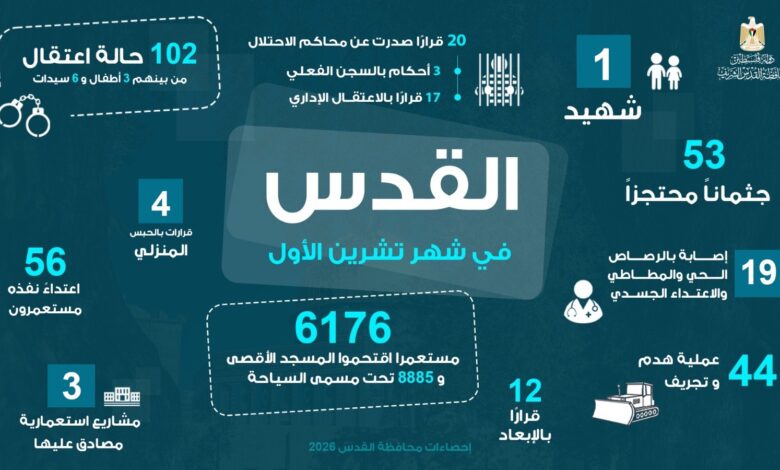
Jerusalem (UNA/WAFA) - The Jerusalem Governorate, during the past month of October, monitored an escalation in the violations of the Israeli occupation and its settlers in the governorate, which resulted in the martyrdom of a citizen, while 6176 settlers stormed the blessed Al-Aqsa Mosque, and the occupation authorities carried out 44 demolition and bulldozing operations.
The young man, Bahaa Sami Amin Al-Natsha (19 years old), from the town of Kafr Aqab, north of occupied Jerusalem, was martyred on October 2, 2026, after being shot by settlers while he was at his family’s farm in the town of Kobar, north of Ramallah.
The martyrdom of Al-Natsha comes in the context of escalating settler attacks throughout the West Bank, which take many forms, including attacking citizens and their homes, assaulting agricultural lands and property, uprooting trees, and seizing land.
During the month of October, the Jerusalem Governorate recorded the storming of (6,176) settlers of the blessed Al-Aqsa Mosque, in addition to the entry of (8,885) others under the guise of “tourism”, under the protection of the occupation forces.
The month witnessed an escalation in the imposition of public Torah rituals inside the mosque, including group prayers, chants, singing and dancing, performing what is called “epic prostration”, introducing the “four varieties” of plants, and raising the occupation flag in front of the Dome of the Rock.
Violations continued in the vicinity of the mosque, including the performance of Talmudic rituals near the Gate of Mercy, targeting of the eastern area, and incitement to storm the compound. These violations included the arrest and week-long banishment of Sheikh Khalid Abu Juma'a, the preacher of Al-Aqsa Mosque, and attacks on employees of the Jordanian Islamic Waqf, in addition to the storming of the mosque by the extremist minister Itamar Ben-Gvir, accompanied by Knesset member Moshe Feiglin, on October 26.
October 2026 witnessed (19) injuries among Palestinians as a result of attacks by Israeli occupation forces and settlers. These injuries included live and rubber-coated bullets, severe beatings, tear gas, and falls from the separation wall. The injuries were distributed across several areas of the governorate, most notably Qalandiya camp, Al-Ram, Abu Dis, Al-Eizariya, Qatanna, and the Jaba' and Container checkpoints.
The governorate documented the implementation of (56) attacks by settlers, including (5) cases of physical abuse, one of which resulted in the martyrdom of the young man Bahaa Al-Natsha (19 years old).
The attacks included burning homes, mosques and trees, stealing livestock and crops, uprooting olive trees, assaulting citizens and farmers, seizing land and restricting access to it, as well as closing roads and isolating residential neighborhoods, targeting Christian holy sites and racial incitement, in the context of attacks that affected Bedouin communities, Palestinian neighborhoods, property and agricultural lands in the governorate and its surroundings.
During the month of October, the Jerusalem Governorate recorded the arrest by the Israeli occupation authorities of (102) citizens, including (6) women and (3) children, in a campaign that targeted various towns and villages of the governorate, the Qalandia and Shuafat camps, the Old City, the vicinity of the blessed Al-Aqsa Mosque and the military checkpoints.
The month witnessed the targeting of educational, municipal and religious figures, most notably the principal of Al-Eizariya Girls School and member of the municipal council, Randa Abu Ziad, the guard of Al-Aqsa Mosque, Mahmoud Khader Abu Ghazaleh, and the mosque’s preacher, Sheikh Khaled Abu Jumaa, who was released with a decision to ban him from the mosque for a week, renewable.
Israeli occupation courts continue to issue rulings against Jerusalemites, including imposing severe restrictions on their movement, such as exorbitant fines that burden families, forced house arrest, deportation orders, and travel bans. The occupation courts have also continued to extend administrative detention without specific charges in some cases, and for extended periods, as documented by the Governorate, raising serious human rights concerns regarding fair trial guarantees.
According to what the governorate monitored, the Israeli occupation’s repressive policy against Jerusalemite prisoners and detainees continued, and it documented (20) decisions and rulings, which were distributed between (3) actual prison sentences and (17) administrative detention decisions, targeting prisoners from various towns and neighborhoods of the occupied Jerusalem Governorate, including children, employees of the Islamic Waqf Department and released prisoners.
During October 2026, the Israeli occupation authorities continued to use house arrest as a tool of punishment and restriction against Jerusalemites, particularly young people, as part of measures aimed at restricting their movement and imposing limitations on their daily lives. The Jerusalem Governorate recorded four house arrest orders during the month, affecting four young people, and these orders were accompanied by the imposition of financial guarantees.
The Jerusalem Governorate recorded the issuance of (12) deportation orders against Jerusalemites, including (10) orders to deport them from the blessed Al-Aqsa Mosque, for varying periods ranging between one week and six months.
The decisions also included banishment from the city of Jerusalem and the Old City, in addition to imposing financial guarantees on a number of those banished.
Demolition, bulldozing, and property seizure operations:
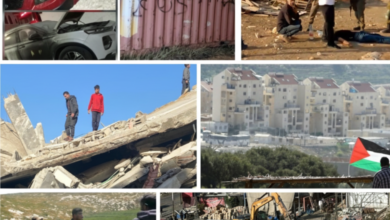
During October, the Jerusalem Governorate documented a total of (44) demolition and bulldozing operations, distributed between (13) self-demolition operations in which the occupation authorities forced citizens to demolish their homes with their own hands under the weight of financial fines and threats, and (29) demolition operations carried out by the occupation’s machinery, in addition to two land bulldozing operations.
These operations included houses, apartments, and multi-story buildings, resulting in the displacement of dozens of citizens, including children, and causing material and social losses to the affected families.
The occupied city of Jerusalem witnessed an escalation in demolition and bulldozing operations, including the demolition of homes and residential structures in the towns of Sur Baher, Silwan, Al-Tur, Beit Hanina, Biddu, Wadi Qaddum, and Qalandiya, whether through demolition operations carried out by the occupation forces or by forcing homeowners to demolish them themselves, under the pretext of building without a permit.
The occupation forces also blew up the house of the Jerusalemite prisoner Qadri Samara in the town of Biddu, and demolished a five-story residential building in the town of Al-Tur, after evacuating its residents, while other areas witnessed the completion of the demolition of houses belonging to Jerusalemite families.
Demolition, forced eviction, and land seizure decisions:
The governorate indicated that the occupation issued (41) notices and decisions targeting Palestinian homes and facilities in the towns of Al-Tur, Al-Issawiya, Anata, Silwan, Hizma and Qalandiya village, distributed between (40) notices and decisions for demolition and cessation of construction, and one eviction decision, within the framework of escalating measures that threaten the residential presence of Jerusalemite families.
The notices included a residential building consisting of (15) floors in the town of Al-Tur, and three residential towers in Anata, in addition to houses and facilities in Silwan, Hizma and Al-Issawiya, while a decision was issued to evacuate a residential building in the village of Qalandia.
During October 2026, the Jerusalem Governorate witnessed an escalation of Israeli violations against Jerusalem institutions and landmarks, through arrest, deportation, physical assault, and administrative harassment.
On October 14, settlers burned a mosque, a vehicle, and an olive tree in the village of Mikhmas. The occupation authorities renewed the administrative detention of Waqf employees Mahdi Abisan and Abdul Rahman Al-Sharif, arrested Al-Aqsa guard Mahmoud Abu Ghazaleh, expelled employee Raed Azghir, and arrested the mosque preacher Sheikh Khaled Abu Juma and expelled him for a week.
The violations extended to educational institutions, with the storming and vandalism of the Al-Eizariya Girls' Secondary School, the imposition of restrictions on its principal, Randa Abu Ziad, and the obstruction of students from the Shuafat camp from reaching their schools. The occupation government also refused to allow the Central Elections Committee to enter Jerusalem and Gaza to monitor the legislative elections.
On October 8, the occupation forces assaulted the mayor of Al-Eizariya, Atta Jabr, and vandalized four houses belonging to him and his family.
These incidents reflect a simultaneous targeting of religious, educational and municipal institutions, restricting their ability to perform their duties and violating the rights of the Palestinian population.
Last month, the Israeli occupation authorities continued to target Jerusalemite prisoners and released detainees by renewing administrative detention, issuing actual prison sentences, re-arresting and deporting them, while violations continued inside prisons.
The measures included renewing the detention of Waqf employees Mahdi Abisan and Abdul Rahman Al-Sharif for two months for the second time, rejecting the appeal of Jerusalemite Raeda Saeed against her one-year prison sentence, and obliging her to turn herself in on November 12.
Jerusalemite John Qaqish was released on the condition that he be kept away from Jerusalem for five days, while editor Muhammad Ubaidat was re-arrested.
The suffering of the prisoners was exacerbated by medical neglect, denial of treatment, malnutrition, and a lack of hygiene supplies, clothing, and blankets, in addition to assaults and raids.
Prisoner support organizations reported that more than 90 female prisoners are facing torture, starvation, harassment, and denial of medical treatment, with scabies spreading among them. The occupation authorities also continue to hold Jerusalemite prisoner Bushra al-Taweel in solitary confinement for nearly two months, raising concerns for her life.
Based on daily monitoring of official announcements issued by the occupation municipality in Jerusalem, in addition to what was documented by the Orient House Center, the Jerusalem Governorate documented a total of (11) colonial plans, projects and activities during the month of October 2026, including structural plans, colonial projects, the establishment of colonial outposts, road construction works and land-related procedures.
The data showed that among these activities was the deposit of (2) colonial plans aimed at establishing public buildings and institutions, on a total area of (22.420) dunams, while the occupation authorities approved (3) colonial plans that included the establishment and addition of (475) colonial units, on a total area of (14.501) dunams.
It should be noted that the number of units included in this statistic is limited to residential colonial units only, and does not include buildings and facilities designated for public, educational, health, religious, commercial and service uses.
In this context, the Jerusalem Governorate monitored during October of 2026 the issuance of (4) colonial tenders to build (1,629) colonial housing units, distributed among the settlements of “Pisgat Ze’ev”, “Givat Hamatos”, “Gilo”, and “Ma’ale Adumim”.
(is over)